B2B interview recruiting: LinkedIn vs panel vs recruiter
LinkedIn, a panel, or a specialist recruiter: three ways to find B2B professionals for interviews, and each fails in a different way. When to use each, how to verify participants, and how to plan for cancellations.
 By Jennifer Ray, founder of Valid N ResearchPublished
Three routes, one goal
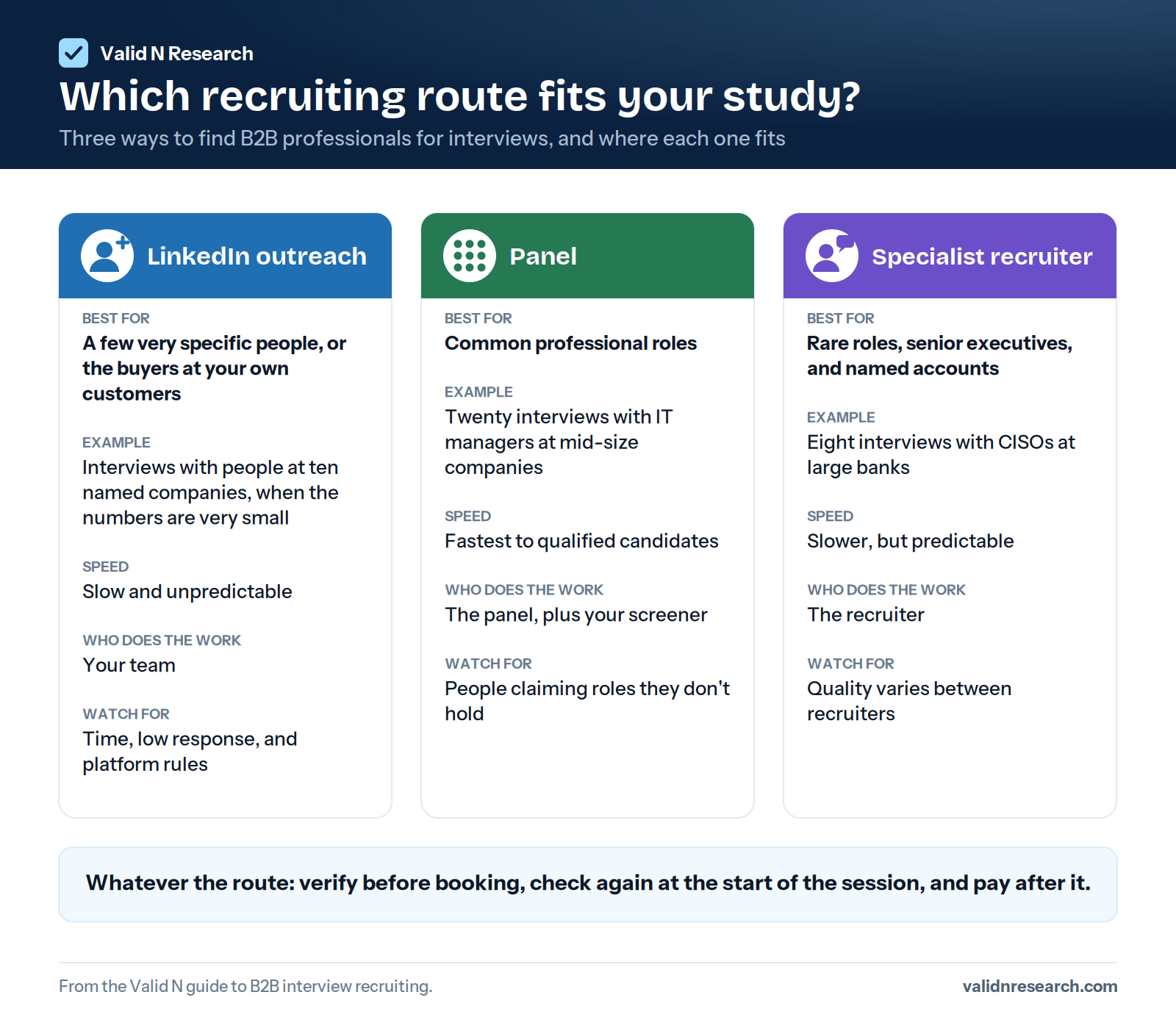
LinkedIn outreachA few very specific peoplePanelCommon professional rolesSpecialist recruiterRare roles, executives, named accountsWhichever you pick, verify participants before booking and again at the session.
Key points
LinkedIn outreach
LinkedIn outreach suits small, very specific recruits where you know exactly who you want. It's slow, it's your team's time, and you have to stay within LinkedIn's rules.
Panel
A panel is usually the fastest way to find qualified people for roles that are common enough to be profiled in advance. The screener does most of the work.
Specialist recruiter
A specialist recruiter is worth the cost for rare roles, senior executives, and named accounts.
- Whatever the route, verify participants before booking and again at the start of the session, not after it.
- Recruit standbys for senior audiences, because cancellations are part of the job.
You need eight in-depth interviews (IDIs) with CISOs, or twenty with IT managers, or a focus group of small business owners. There are three common ways to find them: message people on LinkedIn yourself, use a panel of pre-profiled professionals, or hire a specialist recruiter. Each can work, and each fails in a different way.
Here's when to use each route for qualitative research, what to watch for, how to verify that the people who show up are who they say they are, and how to plan for the cancellations that come with senior participants.
The three routes at a glance
| At a glance | LinkedIn outreach | Panel | Specialist recruiter |
|---|---|---|---|
| Best for | A few very specific people, or your own customers' buyers | Common professional roles | Rare roles, executives, named accounts |
| Speed | Slow and unpredictable | Fastest to qualified candidates for common roles | Slower, but predictable |
| Who does the work | Your team | The panel, plus your screener | The recruiter |
| Main risk | Time, low response, and platform rules | People claiming roles they don't hold | Quality varies between recruiters |
| Verification | Up to you | Depends on the panel | Depends on the recruiter, so ask |
Expert networks are a fourth route for some studies. They connect you with individual experts, often former executives, for paid calls, usually with compliance rules about what can be discussed. They suit strategy and investment research better than most customer or market research, which is what this guide covers.
Route 1 of 3
Recruiting on LinkedIn yourself
LinkedIn is where B2B professionals list their roles, so it's a natural place to look. For a handful of very specific participants, such as the heads of procurement at ten named companies, it can be the most direct route.
What works
- A short, specific message. Who you are, why this person, what the conversation is about in general terms, how long it takes, and what you're offering for their time.
- No sales angle. Senior people are wary of research requests that turn into sales calls. Say plainly that it isn't one, and keep that promise.
- An easy next step. A link to pick a time, or a short screener, rather than a back-and-forth about availability.
What to watch
- The platform's rules. LinkedIn's User Agreement prohibits scraping and using unauthorized automation tools. Mass messaging tools and scraped contact lists put your account at risk and aren't a sound basis for research recruitment.
- Your team's time. Finding, messaging, following up, scheduling, rescheduling, and paying participants all fall to you, including any tax paperwork that larger payments bring. For more than a handful of interviews, that adds up quickly.
- Response rates. Busy professionals can easily ignore unsolicited messages from people they don't know. Plan for many more messages than interviews.
- Who you end up with. People who respond to LinkedIn messages are, by definition, active on LinkedIn and willing to answer a message from someone they don't know. That's a narrower group than the role as a whole.
- What a profile proves. A profile shows the role someone has listed. It doesn't prove that the person who replies, or who turns up to the call, is the person on the profile, so check again at the session.
- Personal data. Keep only what you need to recruit and schedule, and don't build spreadsheets of profile data you don't need. Get consent before recording, and tell participants where the recording is kept, who can see it, and for how long.
Route 2 of 3
Recruiting from a panel
A panel is a group of people who have agreed to take part in research and have given profile information in advance, such as job title, industry, and company size. For roles that are common enough to be profiled, a panel is usually the fastest way to find qualified people, though scheduling the sessions still takes time.
What works
- A strong screener. The panel's profile gets you close, and the screener decides who qualifies. Our guide to IT decision maker screener questions shows what that looks like, and the same principles apply to qualitative recruits.
- An open question in the screener. For interviews, ask one question people answer in their own words, so you can see whether they can talk about the topic in depth before you book an hour.
- A rescreen before booking. For interviews, a short follow up question or call before confirming catches people whose answers don't hold up.
- Clear information for participants. The topic in general terms, the time, the format, whether it's recorded, and the incentive.
What to watch
- Title inflation. People who want the incentive may claim a more senior role than they hold. Ask how the panel verifies members, and use knowledge questions in the screener.
- Professional respondents. Frequent participants aren't necessarily dishonest, but some studies want people who haven't taken part recently. Ask for a participation limit if it matters.
- Depth for rare roles. A panel with plenty of IT managers may have very few enterprise CISOs in one industry. Ask for feasibility on your specific profile, not the role in general.
- Survey panels used for interviews. Many panel members join to take surveys. For an interview, treat them as higher risk for rehearsed answers, and rescreen before booking.
Route 3 of 3
Using a specialist recruiter
A specialist recruiter finds participants for your study specifically, by phone, email, professional networks, and their own databases. It's slower and more expensive than a panel, and for rare roles or very senior people, it's often the only route that works.
When it's worth it
- Rare roles, where the whole reachable population is small.
- Senior executives, who are less likely to join panels and are often easier to reach through a personal approach. Our C-suite page covers this audience.
- Named accounts, where you need people at specific companies.
- Specific experience, such as people who evaluated a particular product category in the last six months.
What to ask a recruiter
- Where will participants come from, and how will you find them?
- How do you verify that each participant holds the role they claim?
- Is there a screening call before booking, and who makes it?
- What happens if someone doesn't show up, or turns out not to qualify during the session?
- Who sends and collects consent forms, and any NDA the client needs?
- Who pays the incentives, when, and in what form?
- How do you handle and store participants' personal data?
Which route for which study
| Study | Route that usually fits |
|---|---|
| Eight interviews with CISOs at large banks | Specialist recruiter |
| Twenty interviews with IT managers at mid-size companies | Panel, with a strong screener and a rescreen |
| Six interviews with the buyers at your own customers | Introductions through your account or customer success team, with LinkedIn only to find the right person |
| Focus groups with small business owners in one city | Panel or local recruiter |
| Interviews with people at ten named companies | Specialist recruiter, or LinkedIn if the numbers are very small |
| A quick round of interviews with a common role | Panel |
Verifying B2B interview participants
Whatever the route, verify before booking and again at the start of the session. Don't leave it until after.
1Before booking
- Screen on knowledge, not just title. Ask about the systems, decisions, and constraints someone in the role would know. Our fraud prevention guide explains why title alone isn't enough.
- Ask for a work email or a LinkedIn profile. Many participants will share one. A work email at the company they name is stronger evidence than a profile, which anyone can create or embellish. Some people won't share either, often for good reasons, so treat both as supporting evidence rather than a requirement, and have a person review each participant before booking.
2At the session
- Rescreen at the start of the session. A couple of questions about their role and their organization, asked by the moderator, catch many people who got through on rehearsed answers.
- Keep cameras on where the format allows. It helps confirm that one person is taking part throughout, and it supports the other checks. On its own, it doesn't prove identity.
3After the session
- Pay after the session. Release incentives only once the session is complete and the moderator is satisfied the participant matches the profile they were recruited for.
Cancellations and standbys
Senior participants tend to cancel more often than most, because their calendars change at short notice.
- Recruit standbys. Many teams recruit one or two extra participants for every five to eight sessions, and more for executive audiences. Budget for them, because standbys who aren't needed are often still paid, in full or in part, depending on how the recruit was set up.
- Fill extra seats for focus groups. Recruit a couple more people than the group needs, because one person not turning up leaves the whole group short, not just one slot empty.
- Confirm twice. Once a few days before, and again the day before or the morning of the session.
- Offer flexibility. Shorter sessions, early or late slots, and the option to reschedule rather than cancel all help.
- Keep the gap short. The longer the time between booking and the session, the more likely something else gets in the way.
Incentives
Incentives should reflect the participant's time and seniority, and the format matters as much as the amount.
- Scale with seniority and length. A 60-minute interview with an executive needs a different incentive from a 30-minute call with a manager. Ask the recruiter or panel for current rates for your specific profile.
- Check whether they can accept it. Some participants, particularly in government and some regulated industries, can't accept payments, honoraria, or gifts. Offering a donation to a charity of their choice solves this and still appeals to some senior participants. Others need approval before they can accept anything, so allow time for it.
- Be clear upfront. Say what the incentive is, how it's paid, and when, in the first message.
- Don't tie it to answers. The incentive is for the time, regardless of what the participant says.
How we recruit hard to reach B2B participants
For audiences that standard sample can't reach, Valid N recruits participants individually. We ask each participant to verify a work email or LinkedIn profile where they're willing to share one, and a person reviews every participant, including their screening answers, before they're booked. See our hard to reach B2B page for how it works, or send us the brief, and we'll come back with what's reachable.
Related guides
IT decision maker screener questions
A complete example screener with wording, terminate logic, and the knowledge checks that catch fakes.
Read the guideHow to prevent survey fraud and AI bots
AI agents and fake decision makers, a layered defense, false positives, and what to ask any supplier.
Read the guideIncidence lower than quoted?
How to check the math, find the question causing the gap, and the options that protect timeline and budget.
Read the guideB2B interview recruiting: frequently asked questions
How do I find B2B participants for research interviews?
Three routes: message people individually on LinkedIn, recruit from a panel of pre-profiled professionals, or hire a specialist recruiter. LinkedIn suits a few very specific people, a panel suits common professional roles, and a recruiter suits rare roles, executives, and named accounts.
Is a panel or a recruiter better for executive interviews?
Usually a specialist recruiter. Senior executives are less likely to join panels and are often easier to reach through a personal approach. A panel can work for directors and some VPs in common functions, but ask for feasibility on your exact profile.
How much should I pay B2B interview participants?
It depends on seniority, session length, and how rare the role is, so ask your recruiter or panel for current rates for your specific profile. Some participants, particularly in government and some regulated industries, can't accept payment, and a donation to a charity of their choice is a common alternative.
Can I recruit research participants on LinkedIn?
Yes, by messaging people individually. Stay within LinkedIn's User Agreement, which prohibits scraping and unauthorized automation tools, and plan for low response rates and a lot of your team's time.
How long does B2B interview recruitment take?
It depends on how rare the role is. Common professional roles recruited from a panel can take days. Senior executives and rare roles recruited individually usually take longer, so ask for a timeline based on your specific profile.
How many extra participants should I recruit?
Many teams recruit one or two standbys for every five to eight interviews, more for executive audiences, where cancellations are more common, and a couple of extra people for each focus group.
How do I verify that a participant is who they say they are?
Combine several checks: knowledge questions in the screener, a work email or LinkedIn profile the participant shares, a short rescreen at the start of the session, and cameras on where the format allows.
Should I use an expert network instead?
Expert networks suit strategy and investment research, where you want paid calls with individual experts, often former executives. For customer and market research with current practitioners, a panel or specialist recruiter is usually the better fit.
Send the spec. Get real numbers back.
Audience, market, target n, expected interview length. Feasibility the same business day for standard audiences, with reachable counts, an estimated qualification rate we believe and a quoted cost per complete that stays fixed for the agreed brief.