IT decision maker screener questions, with examples
Most IT decision maker screeners ask for a job title and trust the answer. Here is a complete example screener, question by question, with the knowledge checks that catch people who only claim the role.
 By Jennifer Ray, founder of Valid N ResearchPublished
Key points
- Define the audience by role in the purchase, not by job title, and write the qualification rule down before you write a question.
- Never let a question give away the qualifying answer. Hide the target among real alternatives and give every question an honest way out.
- Screen out people who make technology decisions for clients rather than their own organization, such as consultants and managed service providers, unless the study wants them.
- Ask company size as a number, and check it against seniority, title, and spend.
- Add at least one knowledge question about the respondent's own environment, and judge the answer on specifics and consistency, not on how well it's written.
- Soft launch, then read every qualified open end in the first batch of completes.
"IT decision maker" is one of the most requested audiences in B2B research and one of the easiest to fake. A respondent who wants the incentive only has to pick the most senior title on the list and say yes to every technology decision. Ask "Are you involved in IT purchasing?" and nearly everyone who wants to qualify will say yes.
This guide gives you a working screener for IT decision makers, question by question, with the wording, answer options, and terminate logic, plus a one-page summary you can hand to whoever programs it. It also covers the knowledge questions that separate people who run IT from people who have only read about it, the answer combinations worth a second look, and what to check in the first completes.
Who counts as an IT decision maker?
Start with the definition, because every later question depends on it. A title tells you where someone sits. It doesn't tell you what they decide. An IT director at a 40-person firm may approve every technology purchase, while an IT director at a large bank may not approve any.
Most studies care about decision making authority, which usually falls into four levels:
| Role in the purchase | What it means | Studies that usually want it |
|---|---|---|
| Final decision maker | Approves the purchase or signs off on the budget | Pricing, vendor selection, buying-group trackers |
| Shared decision maker | Part of the small group that makes the final call | Most IT decision maker studies |
| Evaluator or influencer | Researches, shortlists, or recommends, but doesn't approve | Messaging, feature priorities, evaluation journeys |
| User only | Uses the technology with no role in choosing it | Usability and satisfaction, rarely decision maker studies |
Decide which levels qualify before you write a single question, and put it in the brief. "IT decision maker" with no definition is how two suppliers can quote the same study at very different incidence rates.
Three things make the definition harder than it looks:
- Enterprise purchases are made by groups. Depending on the size of the deal, IT, security, finance, procurement, legal, and the business unit that will use the product may all shape the outcome. Decide whether the study needs final approvers only, decision makers plus influencers, or the whole buying group.
- Authority is often regional or divisional. Someone can be the final decision maker for EMEA or one business unit without deciding for the whole company. Unless the study expressly needs global authority, those people are real decision makers and shouldn't be screened out.
- Not every technology buyer sits in IT. For many software categories, especially SaaS, business unit leaders choose and pay for the product themselves. If the study covers that kind of purchase, a strict IT-department screen will exclude real buyers.
Define the technology area too. A CISO and an ERP system owner are both IT decision makers, but they buy different things. Screen for the category the study is about, not for IT in general.
Rules that make a screener hard to game
- Don't ask the question with the obvious right answer. "Are you an IT decision maker?" tells the respondent exactly what to say. Ask about job function, seniority, and purchase role separately, each with a full set of options.
- Hide the qualifying answer among real alternatives. List several departments, not just IT and "other."
- Give every question an honest way out. Depending on the question, that's "none of these," "other," "don't know," or "no involvement." Without one, people who don't fit have to pick something, and they pick the answer that qualifies.
- Ask firmographics before the topic. Once respondents know the survey is about cloud security, they know what to claim.
- Ask for numbers you can cross-check. You can compare company size as a number with seniority, title, and spend. A range is easy to pick carelessly. Watch drop off on mobile, though, and switch to narrow ranges if the soft launch shows people abandoning the question.
- Put the likeliest screen outs first. People who don't qualify spend less time in the survey, and the screener stays short for everyone else.
- Make exit options exclusive in multi-selects. "None of these," "we don't use," and "don't know" should clear any other selection, so nobody can pick a real answer and an exit at the same time.
- Randomize answer lists where the order doesn't matter, so the qualifying option isn't always in the same place. Keep scales, such as seniority and purchase role, in their natural order.
- Turn off the back button in the screener. Otherwise, a respondent who screens out can go back, change an answer, and try again.
- Review every "other, please specify" answer. Someone who types "market research" under other, or "IT" in the department question, should be treated as if they'd picked that option.
- Keep it short. About a dozen core questions is usually enough, with optional checks only where the study needs them.
Before the screener: entry checks
A screener catches people who claim a role they don't hold. It doesn't catch duplicate entries or automated respondents, and it shouldn't have to. Those are handled before anyone sees the first question: device and duplicate checks, location checks, and, where the sample source allows it, a verified work email at the employer the respondent names. A VPN on its own is a reason to look at other evidence, not a reason to remove someone, because many professionals connect through a corporate VPN every day.
Our guide to preventing survey fraud and AI bots covers those layers in detail. The rest of this article is about the screener itself.
An example IT decision maker screener
Below is a complete screener for a study of IT decision makers in the US involved in cloud infrastructure purchases at organizations with 100 or more employees. Adapt the market, the category, the size floor, and the qualifying levels to your brief. Programming notes are in bold.
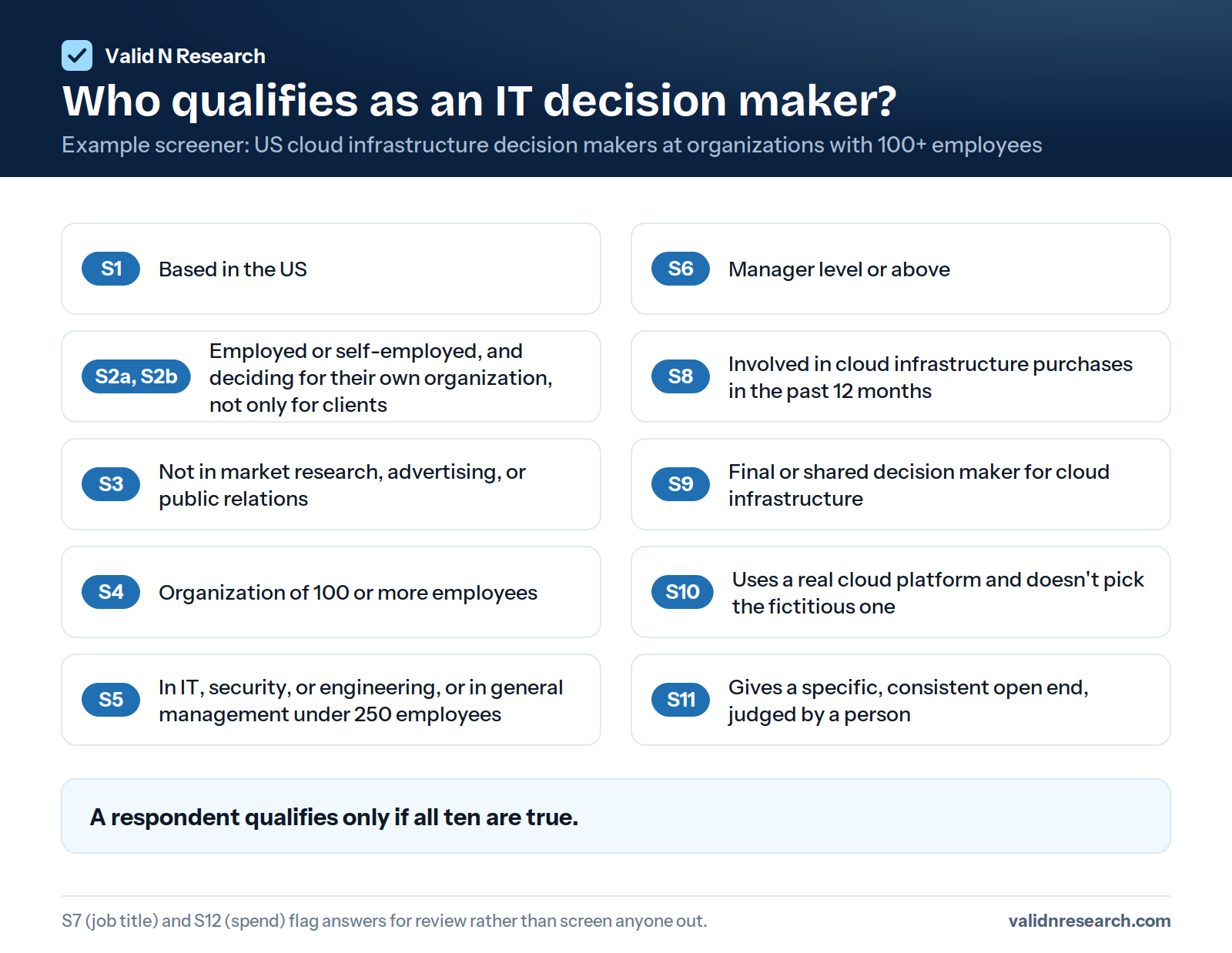
The qualification rule for this example. A respondent qualifies if all of these are true:
- Based in the US (S1)
- Employed or self-employed, and making decisions for their own organization, not only for clients (S2a and S2b)
- Not in market research, advertising, or public relations (S3)
- Organization of 100 or more employees (S4)
- In IT, information security, or engineering, or in general management at an organization under 250 employees (S5)
- Manager level or above (S6)
- Involved in cloud infrastructure purchases in the past 12 months (S8)
- Final or shared decision maker for cloud infrastructure (S9)
- Uses at least one real cloud platform and doesn't select the fictitious one, or in a high-security study prefers not to say and passes review (S10)
- A specific, consistent answer to the open end (S11). This one is judged by a person during field, not programmed as a live terminate.
S1. Country
In which country do you currently work? (Select one)
- United States
- Canada
- United Kingdom
- Germany
- Other (please specify)
Terminate: anything outside the study's markets, which in this example means everything except the United States. Listing a few other countries keeps it from being obvious which one qualifies. Review by hand: other, in case someone types a study market there. Ask this first, since it drives which currency, answer lists, and quotas apply later.
S2a. Employment
Which of the following best describes your current employment? (Select one)
- Employed full time
- Employed part time
- Self-employed or an independent consultant
- Not currently employed
- Student or retired
- Other (please specify)
Continue to S2b: employed full time, employed part time, and self-employed or independent consultant. Terminate: not employed, student, or retired. Review by hand: other. Treat contractor or freelance answers as self-employed and continue to S2b, and terminate anything that amounts to not employed, student, or retired. Everyone who continues answers S2b, including full time employees, because someone employed full time by a consultancy or managed service provider may still be making decisions for clients.
S2b. Whose decisions
When you're involved in technology decisions, are they mainly for... (Select one)
- My own organization (the one I work for or own)
- Client organizations that I advise or provide services to
- Both
- I'm not involved in technology decisions
Continue: my own organization. Continue and flag for review: both. Someone who runs internal IT at a consultancy may also advise clients, so they can be real buyers. The reviewer should read their S11 open end first: if it describes a client's decision rather than their own organization's, remove them. If the open end doesn't make it clear, review the rest of the screener; if it's still unclear, leave them out of a buyer study. Terminate: client organizations and not involved, unless the study wants people who advise on technology for their clients. Consultants, managed service providers, and resellers often know a category well, but their answers describe their clients' decisions, not their own employer's, and that contaminates a buyer study. This question screens on whose decisions someone makes, not on the type of employer, so the internal IT leader at a consultancy or an IT services firm still qualifies as a buyer for their own organization.
S3. Industry
Which of the following best describes the industry your organization operates in? (Select one, randomize)
- Banking, finance, or insurance
- Healthcare
- Manufacturing
- Retail or ecommerce
- Technology or software
- Professional services
- Market research, advertising, or public relations
- Government or education
- Other (please specify)
Terminate: market research, advertising, or public relations, including anyone who types one of those under other. If the study needs to exclude the client's competitors, add a separate question listing several companies so the excluded ones aren't obvious.
S4. Organization size
Approximately how many employees work for your organization worldwide, including all locations? (Enter a number)
Terminate: below the study's floor, 100 in this example. Flag for review: implausible numbers, or numbers that don't fit other answers. Round estimates such as 500 or 5,000 are normal. Validate the entry so it can't be blank, zero, or text. If you offer "don't know," terminate on it, since the question only asks for an approximate number. If the soft launch shows people dropping out here, narrow ranges such as 100 to 249, 250 to 499, and 500 to 999 are a reasonable compromise. Decide in the brief what "organization" means for your study, and say it in the question. If people at subsidiaries should count only their subsidiary, write "the company you work for, not its parent company," because the difference can move someone from mid market to enterprise.
S5. Department
Which of the following best describes your department or area of work? (Select one, randomize)
- Information technology
- Information security
- Engineering or software development
- Finance or accounting
- Operations
- Marketing
- Sales
- Human resources
- Procurement or purchasing
- General management or executive leadership
- Other (please specify)
Continue: information technology, information security, or engineering. For cloud infrastructure, the decision usually sits in those teams, or with executive leadership at smaller firms. For categories that business units often buy themselves, widen this list. Continue if S4 is under 250: general management, since at smaller organizations the owner or COO often runs IT. Add procurement if the study includes the whole buying group, and the relevant business units if the category is often bought outside IT. Review the other answers by hand, since some people type a qualifying department there.
S6. Seniority
Which of the following best describes your level in the organization? (Select one)
- Owner, partner, or C-level executive (for example, CIO, CTO, or CISO)
- Senior vice president or vice president
- Director or head of department
- Manager or team lead
- Individual contributor or specialist
- Administrative or support staff
- None of these
Continue: manager and above, or director and above if the brief requires it.
S7. Job title
What is your job title? (Open end)
Don't qualify on this. Titles vary too much between organizations and are easy to invent. Use it as a consistency check against S6: a "Senior IT Support Technician" who selected C-level is worth a second look. Don't ask for the respondent's name or employer here.
S8. Technology areas
Which of the following technology areas have you been involved in purchasing or renewing in the past 12 months, for your organization or the part of it you're responsible for? (Select all that apply, randomize)
- Cloud infrastructure, such as compute, storage, or hosting
- Cybersecurity software or services
- Networking equipment
- Collaboration or productivity software
- Data and analytics platforms
- ERP or finance systems
- Customer relationship management (CRM)
- Laptops, desktops, or mobile devices
- None of these
Continue: cloud infrastructure selected. Flag for review: anyone who selects every area, especially at larger organizations. Real decision makers are usually involved in some areas, not all, although at an organization near the size floor one senior person may genuinely cover everything. If the study is about upcoming purchases, ask about the next 12 months instead, or add a timing question from the optional list below.
S9. Purchase role
Which best describes your role in your organization's cloud infrastructure decisions? If you make these decisions for a region or business unit, answer for that. (Select one)
- I make the final decision
- I am part of a small group that makes the final decision
- I evaluate options and make recommendations, but don't make the final decision
- I use it but have no role in choosing it
- I have no involvement
Continue: the answers your screener accepts, the first two in this example. Keep this list in its natural order, since it's a scale.
S10. Platforms in use
Which cloud platforms does your organization, or the part of it you make these decisions for, currently use? (Select all that apply, randomize)
- Amazon Web Services (AWS)
- Microsoft Azure
- Google Cloud
- Oracle Cloud Infrastructure
- IBM Cloud
- A plausible but fictitious platform name
- We don't use a cloud platform
- Don't know
Terminate: "we don't use a cloud platform" and "don't know," and make both exclusive. Anyone closely involved in cloud infrastructure decisions would normally know which platforms are in use. Expect several answers from many respondents, since plenty of organizations run workloads on more than one platform. Also terminate: anyone who selects the fictitious platform. That's a trap question. Use one per screener at most, and make sure the name isn't a real product in any of your markets and doesn't sound like one. Flag for review: anyone who selects every real platform. Some large enterprises do run all of them, but most organizations don't, so check it against organization size (S4).
In defense, government, and other high-security sectors, some people aren't allowed to name vendors. For those studies, add "prefer not to say" as an exclusive option and judge those respondents on their other answers, especially the open end, rather than terminating them.
S11. A recent decision
In a sentence or two, describe the most recent cloud infrastructure decision you were involved in. What was being decided, and what was your part in it? Please don't include names or confidential details. (Open end)
Review against the rubric below. This is the category knowledge question, and it catches more fake decision makers than any closed question.
| Result | What it looks like | What to do |
|---|---|---|
| Pass | Names something specific, such as a workload being moved, a vendor comparison, a contract renewal, a cost problem, or a region or compliance requirement, and describes a part in it that fits S9 | Qualify |
| Review | Plausible but generic, or specific but at odds with other answers, such as describing an Azure migration after selecting only AWS in S10 | A person reviews it with the rest of the screener |
| Remove | Off topic, nonsense, copied from another respondent, or "we chose the best solution for our business needs" with nothing behind it | Screen out |
A person should make the call on anything in the review band, looking at the whole screener rather than the open end alone. For anyone who answered "both" at S2b, also check that the decision described is their own organization's, not a client's.
S12. Spend
Which best describes the annual spend on cloud infrastructure (compute, storage, and hosting, not the total IT budget) for the organization, or the part of it you make these decisions for, in US dollars? (Select one)
- Under $50,000
- $50,000 to $249,999
- $250,000 to $999,999
- $1 million to $4.9 million
- $5 million or more
- Don't know
Spend is one place where ranges are better than an open number, because people are more willing to answer. For studies in several countries, convert the ranges to local currency rather than asking everyone in dollars. Flag for review: spend that doesn't fit organization size, such as $5 million or more at a 120-person manufacturer, and "don't know" from someone who said in S9 that they make or share the final decision. "Don't know" is reasonable from an evaluator. Read spend alongside industry (S3), because a software company with 120 people can genuinely spend that much on cloud.
Optional checks
Add these only if the study needs them. Each one adds length.
- Team size. "How many people report to you, directly or indirectly?" A director or VP with no reports, or a manager with hundreds, is worth a look. Some senior specialists genuinely manage nobody.
- Approval limit. "What is the largest cloud infrastructure purchase you can approve without anyone else's sign off?" with ranges and "I can't approve purchases on my own." This is one of the best checks on a final decision maker claim, because people who inflate their influence rarely think about approval limits. Compare the answer with the respondent's level and the size of the organization, not with annual spend, since a single purchase or a multi-year contract can legitimately exceed a year's spend.
- Purchase timing. "Are you planning or evaluating a cloud infrastructure purchase in the next 12 months?" For studies that need active buyers rather than recent ones.
- Competitor exclusion. A list of several companies, including the client's competitors, asking whether the respondent works for any of them.
The screener on one page
| Question | Purpose | Continue | Terminate | Flag for review |
|---|---|---|---|---|
| S1 Country | Market | Study markets | All others | Other, reviewed by hand |
| S2a Employment | Employment status | To S2b: employed full or part time, self-employed or consultant | Not employed, student, retired | Other, reviewed by hand |
| S2b Whose decisions | Deciding for own organization | Own organization, and both after review | Clients only, not involved | Both, checked against the S11 open end |
| S3 Industry | Security screen | All others | Market research, advertising, PR, including under other | Other, reviewed by hand |
| S4 Organization size | Firmographic floor | 100 or more | Under 100, and don't know if offered | Implausible numbers |
| S5 Department | Function | IT, security, or engineering, plus general management under 250 | All others | Other, reviewed by hand |
| S6 Seniority | Level | Manager and above | Below manager | Title mismatch at S7 |
| S7 Job title | Consistency check | Everyone | None | Title that doesn't fit S6 |
| S8 Technology areas | Category involvement | Cloud selected | Cloud not selected | Every area selected, mainly at larger organizations |
| S9 Purchase role | Authority | Final or shared decision | Evaluator, user, none | None |
| S10 Platforms | Knowledge check | At least one real platform, or prefer not to say in high-security studies | Don't use, don't know, fictitious platform | Every real platform selected |
| S11 Recent decision | Knowledge check | Pass on manual review | None, since this isn't programmed | Review or remove, by a person |
| S12 Spend | Consistency check | Everyone | None | Spend that doesn't fit size and industry, or "don't know" from a final or shared decision maker |
Answer combinations worth a second look
The questions are designed to be read as a set. Seniority, title, organization size, purchase role, platforms, spend, and the open end should tell one consistent story.
| Combination | Why it's worth a look |
|---|---|
| Job title that doesn't match the seniority selected | Title inflation or careless answering |
| Involved in every technology area at a larger organization | Overclaiming responsibility |
| Answered "both" at S2b | The open end may describe a client's decision rather than their own organization's |
| Final or shared decision maker who doesn't know cloud spend for the area they decide for | A possible gap in what a decision maker would normally know |
| Open end describes a platform not selected in S10 | The answers don't describe the same organization |
| An approval limit that doesn't fit the respondent's level or the organization's size | Possible inflated authority |
| Every option selected in the multi-select questions | Overclaiming, or clicking without reading |
| A screener completed far faster than most respondents take | Not reading the questions |
| Long, polished open end submitted seconds after the page loaded | Possibly pasted or generated elsewhere |
Treat each flag as a reason to look, not a reason to remove. One odd answer usually has an innocent explanation. Several that don't fit together usually don't. Removing people on a single signal throws out genuine respondents along with the fakes, which our fraud guide explains in its section on false positives.
Review during field, not at the end. A person should check flagged screeners and open ends at the soft launch and then regularly while the study is running, so removals are replaced from the same quota cell while field is still open. Leaving it until the field closes means either keeping doubtful completes or reopening the survey to replace them.
Screening when AI can write the answers
AI tools can now write a believable paragraph about a cloud migration in seconds, so a well-written open end proves less than it used to. A few adjustments help:
- Ask about the respondent's own environment, not the industry. "Which platform hosts most of your production workloads, and roughly how many regions do you run in?" is harder to answer from general knowledge than "What are the benefits of multi-cloud?"
- Weight consistency above writing quality. A generated answer can be fluent and still contradict the platforms, spend, and role selected earlier. The combinations above catch that.
- Treat formatting tells as a reason to look, not proof. Bullet points, a formal tone, or a long answer pasted in almost instantly are worth a second look. AI text detectors are unreliable, and they misfire more often on people writing in a second language, so don't remove anyone on a detector score alone.
Knowledge questions by technology area
Swap S10 and S11 for the area your study covers. These questions work because a practitioner answers them in a second, while someone guessing either gives a generic answer or names the most famous brand in the category.
| Area | Example question | Answers you might see |
|---|---|---|
| Identity and access | Which identity provider does your organization use for employee sign-in? | Okta, Microsoft Entra ID (formerly Azure AD), Ping Identity |
| Security | Which endpoint protection product runs on company laptops? | CrowdStrike, Microsoft Defender for Endpoint, SentinelOne |
| Cloud | Which cloud platform hosts most of your production workloads? | AWS, Microsoft Azure, Google Cloud |
| Data | Which data warehouse or lakehouse does your team query most? | Snowflake, Databricks, BigQuery, Redshift |
| ERP and finance systems | Which ERP system runs your month-end close? | SAP, Oracle, Microsoft Dynamics, NetSuite |
| Networking | Who is your primary networking hardware vendor? | Cisco, Juniper, Arista, HPE Aruba |
| Collaboration | Which platform does your organization use for internal chat? | Slack, Microsoft Teams, Google Chat |
Two cautions. Offer "prefer not to say," because some security teams aren't allowed to name their vendors, and that's an honest answer. And judge the answer for specificity, not correctness. You're checking that the person knows their environment, not that it matches an answer key.
Mistakes that let the wrong people through
- Yes or no questions about responsibility. "Are you responsible for technology purchasing?" invites a yes.
- Only one plausible answer. A department list of "IT" and "other" tells the respondent which one to pick.
- Revealing the topic too early. A survey titled "Cloud security decision maker study" has already told people what to claim.
- Treating consultants as buyers. People who advise clients on technology often pass every knowledge check, because they know the category well. Their answers still describe someone else's decisions.
- Qualifying on job title alone. Use the title as a consistency check, not as the qualifier.
- Loosening the screener to hit incidence. If the screener lets users through to fill quota faster, the data blends people who choose technology with people who use it, and the results look fine and are wrong.
What to check in the soft launch
A soft launch is the cheapest place to find screener problems before you spend most of the budget. In the first batch of completes, check:
- Actual incidence against the estimate. A big gap in either direction means the definition, the screener, or the sample needs another look.
- Terminate rates by question. If one question screens out far more people than expected, it may be too strict, badly worded, or programmed wrong.
- The share of flagged respondents, and which flags are firing.
- Every qualified open end. Read all of them in the first 10 to 20 completes. Many screening problems become obvious by then.
- Quota pacing and completion times, so a cell that's filling suspiciously fast gets looked at early.
What tighter screening does to incidence and cost
Every check you add qualifies fewer screener starts. If a tighter screener qualifies one start in ten instead of one in five, you need twice as many starts for each complete, and cost per complete rises. The incidence rate calculator and the cost per complete estimator show how much.
That trade is usually worth making, because the alternative is paying less for data from the wrong people. Send the actual screener with your feasibility request, since a quote is only as accurate as the definition behind it.
Privacy and local markets
- Keep personal details out. Don't ask for names, email addresses, or employer names in the screener unless the study needs them and respondents have agreed. Ask respondents not to include names or confidential details in open ends.
- Keep trap options clearly fictitious. A made-up name that happens to belong to a small real vendor turns a fair check into an unfair one.
- Localize answer lists, not just the wording. Vendor lists, industries, and job levels differ by country, and titles don't map neatly across markets. A "director" in one country can be a much more senior role than in another.
How we screen IT decision makers
At Valid N, every respondent, from our own panel or partner sources, answers role and knowledge questions like the ones above before entering your survey. Our panel members also verify a work email at the employer they name when they join, and again every 90 days. When we host the survey, a person reviews the screening answers and removes anyone whose answers don't hold up. When you host it, your screener runs in your survey, and our pre-screen still runs first.
Our IT decision makers page covers the audience in more detail, and our data quality page explains each layer. If you have a study coming up, send us the brief and your screener, and we'll come back with feasibility based on it.
Related guides
How to prevent survey fraud and AI bots
AI agents and fake decision makers, a layered defense, false positives, and what to ask any supplier.
Read the guideB2B concept test sample size
What 100, 200, and 300 per cell buy you, and how to design around a small, expensive audience.
Read the guideSurvey fraud red flags in B2B research
The signals that a respondent is not who they claim, how to catch them, and what to ask your vendor.
Read the guideIT decision maker screeners: frequently asked questions
How do you screen for IT decision makers in a survey?
Ask about job function, seniority, organization size, and role in purchases for the specific technology category as separate questions, each with a full set of options. Screen out people who make technology decisions for clients rather than their own organization, such as consultants and managed service providers. Then add at least one knowledge question about the respondent's own environment, such as which cloud platform or identity provider their organization uses, and check that the answers fit together.
What are good screener questions for a B2B survey?
Ask questions that establish country, employment, industry, organization size, department, seniority, and role in purchasing, then follow with a question only someone in the target role can answer specifically. Avoid yes or no questions about responsibility, give every question an honest way out, and ask about the topic only after the firmographics.
How do you catch fake respondents in a B2B screener?
Look for answers that don't fit together, such as a senior title with a junior job description, involvement in every technology area, or spend that doesn't match organization size. Add a knowledge question about the respondent's own environment, and have someone review the open end to check that it's consistent with the rest of the screener. Apart from the trap question, no single odd answer proves anything, so remove people on combinations, not one flag.
How many questions should an IT decision maker screener have?
Usually about a dozen core questions. That's enough to establish market, employment, whose decisions someone makes, function, seniority, organization size, purchase role, and at least one knowledge check. Add optional checks only when the study needs them, because every question adds drop off.
Should I ask for job title as open text?
Yes, as a consistency check against the seniority level someone selects, but don't qualify on it alone. Titles vary too much between organizations and are easy to invent.
What's the difference between an IT decision maker and an IT influencer?
A decision maker approves or shares approval of a purchase. An influencer researches, evaluates, or recommends but doesn't sign off. Many studies want both, so define which levels qualify in the brief.
Should IT consultants and managed service providers qualify?
Usually not for a buyer study. They often know the category well, but their answers describe their clients' decisions rather than their own employer's. Someone who makes decisions for both their own organization and clients can qualify once a reviewer has checked that their answers describe their own organization. Include people who only advise clients when the study is specifically about the people who advise on technology.
Can a screener stop bots and survey fraud?
Only part of it. A good screener stops people who claim a role they don't hold. Bots and duplicate entries need device and identity checks at entry, and AI tools can now write fluent open ends, so no screener is proof on its own.
Should the screener tell respondents what the survey is about?
Not until they've qualified. Once people know the topic, they know which answers qualify.
How do I screen for purchase authority without leading respondents?
Ask about their role in decisions in one specific category, with a full scale from final decision maker to no involvement, and ask it after function and seniority. An approval limit question is a useful second check on anyone who claims final authority.
Send the spec. Get real numbers back.
Audience, market, target n, expected interview length. Feasibility the same business day for standard audiences, with reachable counts, an estimated qualification rate we believe and a quoted cost per complete that stays fixed for the agreed brief.