B2B survey incentives: what works and how much to pay
Cash, gift cards, prize draws, donations, or the results? What the research tells us about B2B survey incentives, how much to pay, and the rules that apply when your respondents are professionals.
 By Jennifer Ray, founder of Valid N ResearchPublished
Quick answer
Cash or a direct cash equivalent
Promise it in the invitation and pay promptly after your checks. For senior people who care about the topic, a summary of the results can also work.
Why: Which kind of incentive works bestPrize draws were among the least effective incentives in the research, so skip them in most cases.
You're about to survey your own customers, your own members, or a third party contact list, and someone asks what you're offering them. A $10 gift card? A big prize draw? A donation to charity? Or just a copy of the results?
The evidence is pretty consistent, though most of it is drawn from surveys of the general public and of doctors rather than business buyers. This guide looks at what the research has to say about B2B survey incentives, how much to pay, and the rules that apply when your respondents are professionals.
Key points
- Incentives boost response rates in surveys of organizations, not just consumers. A meta-analysis of 34 experiments in organizational surveys found a small but highly significant effect.
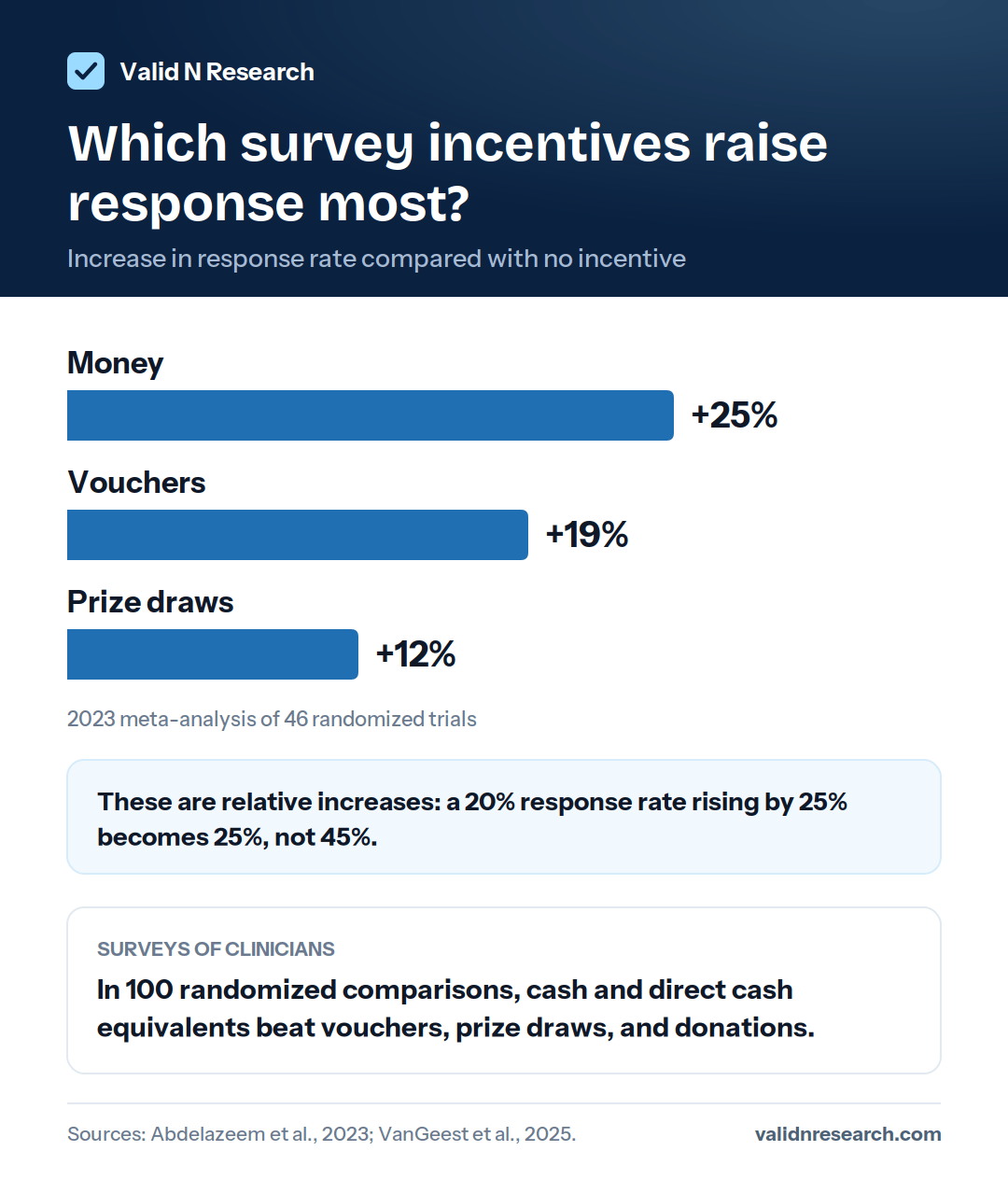
- Money usually works better than other rewards. In surveys of clinicians, cash and direct cash equivalents beat vouchers, prize draws, and charity donations. Prize draws are among the weakest options in the research, even when the prize is large.
- Paying everyone up front works better than paying only those who respond, at least in mail surveys. Online, it's rarely practical.
- Larger incentives can raise response, but the gain varies by audience and survey mode, and it tends to shrink as the amount grows.
- Some professionals may be restricted from accepting an incentive, so have an alternative ready, such as the results or a donation.
- If you buy panel sample, the supplier pays the incentive, and it's built into the cost per complete.
Do incentives work in B2B surveys?
Yes, but the effect is modest, and most evidence comes from surveys of organizations and clinicians rather than business buyers specifically.
| Study | Who was surveyed | What it found |
|---|---|---|
| Torres van Grinsven and Hox, 2014 (conference paper, reported in Torres van Grinsven's 2015 thesis) | Meta-analysis of 34 incentive experiments in surveys of organizations | A small but highly significant effect on response, largest in surveys run by commercial organizations |
| VanGeest, Johnson and Kapousouz, 2025 | 100 randomized comparisons in surveys of clinicians | Even incentives of $2 or less raised response. Cash and direct cash equivalents beat vouchers, prize draws, and donations. |
| Cochrane review, 2023 | Randomized trials of electronic questionnaires | Monetary incentives raised the odds of response by about 88%, nonmonetary incentives by about 60%, and an offer of the results by about 36% |
| Göritz, 2006 | Experiments in web surveys | Incentives raised the odds of starting by about 19% (32 experiments) and the odds of finishing by about 27% (26 experiments) |
How to read these figuresTwo notes on reading these figures. Higher odds aren't the same as that many more percentage points: for example, if 20% of people respond, 88% higher odds brings that to about 32%. And each Cochrane estimate comes from the trials that evaluated that particular change, not from all 88 electronic trials in the review, with results that varied between trials.
The organizational meta-analysis is the most relevant to B2B. It found an average effect size of 0.25 on the standard scale for comparing experiments (Cohen's d, where 0.2 is considered small, 0.5 medium, and 0.8 large), so incentives had a modest but real effect on response. Surveys run by commercial organizations showed the largest effect, 0.36. The authors attributed that to lower response rates without an incentive in those surveys, which left more room for one to help. In that analysis, neither the type nor the value of the incentive made a significant difference.
For senior business audiences, there's less evidence. Cycyota and Harrison found only one study of executives that mentioned a gift or incentive, too few to test, and the 2026 update didn't test incentives. Reviews of published management studies are mixed; see our guide to B2B survey response rates.
TakeawayAn incentive helps, but it doesn't replace a topic that matters to the respondent or a short survey.
Which kind of incentive works best?
| Incentive | What the research found | When it fits |
|---|---|---|
| Cash or a direct cash equivalent, such as a check, a prepaid cash card, or a bank or PayPal transfer | The most effective form in the clinician review. It also had the largest estimated effect in a 2023 meta-analysis. | Most surveys, when respondents can accept it |
| Gift card or voucher | Raised response, but less than cash in both reviews | When paying cash isn't practical |
| Prize draw | Among the least effective forms in the clinician review, with the smallest estimated effect in the 2023 meta-analysis | Rarely the best choice. If you use one, check the rules below. |
| Donation to charity | Among the least effective forms for clinicians | Respondents who can't or won't accept payment |
| A summary of the results | Raised the odds of response by about 36% in the Cochrane trials of electronic questionnaires | Short surveys of senior people who care about the topic |
Other meta-analyses have found differences by type, even though the organizational analysis didn't. A 2023 meta-analysis of 46 randomized trials by Abdelazeem and colleagues compared each incentive type with no incentive. Money raised response by about 25%, vouchers by about 19%, and prize draws by about 12%. These are relative increases, not percentage points: a 20% response rate rising by 25% becomes 25%. Each figure compares the incentive with no incentive rather than a head to head test, but money had the largest estimated effect.
Small business owners may view incentives differently. In a 2022 study by Seshadri and Broekemier, small business owners and managers rated a $20 cash payment, a $20 gift card, and a $20 donation to charity about the same, and preferred all three to a $600 prize draw. For a 10 minute survey, they valued an offer of the results about as highly as cash, but less so for longer surveys. So for this group, a small guaranteed reward appealed more than a large chance of one. This is a different population from the clinician studies, and the study measured what people said they would do, not what they did.
TakeawayIn the clinician review and the 2023 meta-analysis, money generally performed best and prize draws performed less well. The organizational meta-analysis found no significant difference by type, so this isn't a universal ranking for B2B audiences. A donation or the results can work for short surveys and for people who don't want payment.
Should you pay up front or after they finish?
In mail surveys, paying everyone when you invite them works better than paying only those who respond. In the Cochrane trials of mail surveys, incentives sent with the questionnaire raised the odds of response by about 53% compared with incentives paid only on return. The usual explanation is reciprocity: people feel they should return a favor. Torres van Grinsven and Hox suggest the same of organizational surveys, where the gesture may matter more than the amount.
That evidence comes from mail surveys, where a few dollars can go in the envelope. There's much less evidence for online surveys, so don't assume the same gain. Paying everyone up front online also means paying the many people who never respond. If you test it, judge it by cost per complete, not just response rate.
TakeawayFor most B2B surveys of your own list, the practical choice is a promised incentive, paid quickly once the survey is complete.
How much should you pay?
There's no published rate card for B2B survey incentives. The evidence on amount points in a few directions:
- More money can help, but the gain varies. In the Cochrane trials of mail surveys, a larger monetary incentive raised the odds of response by about 24% compared with a smaller one. In the clinician review, even small amounts raised response. Above $2, returns diminished, and only amounts above $25 brought a clearer improvement.
- In surveys of organizations, the amount mattered less. The value of the incentive made no significant difference in the organizational meta-analysis.
- Length matters at least as much. Seshadri and Broekemier concluded that survey length affected small business owners' willingness to respond more than the type of incentive did.
Without a rate card, set the incentive from what you're asking of the respondent:
- Length.Base it on a realistic completion time, from a pilot or soft launch if you can, not an optimistic estimate. Pay more for longer surveys. Our guide to B2B survey length covers how to measure it.
- Seniority and scarcity.People whose time is expensive, and audiences with few qualified people, need more.
- Effort.Open ended questions, looking up figures, or agreeing to a follow up call justify more.
- What else they get.A topic they care about, a sender they trust, or results they can use carry part of the weight.
TipIf you're unsure, test two incentive levels on random halves of your list and compare the cost per complete.
Watch forDon't make the incentive the main reason to take part. A large reward gives people a reason to claim a role they don't hold, which is claim fraud. The more you pay, the more it matters to check who you're paying before you release the incentive.
When you might not need an incentive
An incentive is less likely to make a difference when:
- Your audience already responds well. In the organizational meta-analysis, incentives helped most where response without one was low.
- The topic and the sender carry it. For executives, an invitation through someone they trust is the most consistent finding in the research, and a topic that matters to the respondent helps in trials generally.
- Respondents can't accept one. See below.
Even then, a summary of the results costs little to offer.
Who can't accept an incentive?
Some respondents aren't allowed to take one, or would rather not:
- Government employees.US federal employees may face limits on gifts from outside sources, and the small gift exception doesn't cover cash. Whether a particular incentive is allowed depends on the circumstances and agency rules, so respondents may need to check with their ethics office. State and local rules vary.
- Staff covered by company gift policies.Many companies limit what employees can accept from outside organizations, particularly from suppliers.
- Buyers and procurement staff.Paying people who buy from you, or might, can create a conflict of interest. Check their employer's gift and procurement policies, and your own compliance rules, before offering anything, and don't assume a small payment is allowed. Where an incentive is allowed, keep it separate from any purchase, negotiation, or supplier decision.
- People who see payment as the wrong signal.Some senior respondents take part because the topic matters to them, and would rather not be paid for it.
Giving a choice covers most of these cases: payment, a donation to charity, or no incentive, with a summary of the results for everyone who finishes.
Prize draws and the law
A prize draw can also trigger promotion laws. In New York, a game of chance run in connection with consumer products or services, with total prizes over $5,000, must be registered at least 30 days in advance and backed by a trust account or bond. Florida requires qualifying promotions with prizes over $5,000 to be filed at least 7 days in advance, and generally requires a bond or trust account. However, the state can waive that for operators with five years of compliant promotions there. Whether a research survey draw is covered depends on how it's set up, and other states and countries have their own rules, so check before you launch. Either way, a draw should have written rules covering who can enter, the prize, the odds, and the draw date. And if you pay incentives yourself, ask your accountant whether you need to report any for tax.
How to deliver incentives
- Say what it is, how it's paid, and when. Put it in the invitation, in one sentence. If you offer a donation, say which charity, or let respondents choose.
- Pay for time, not answers. Everyone who completes gets the same incentive, whatever their views. Decide in advance what people who don't qualify or stop partway will get, if anything, and say so.
- Check before you pay, using criteria set in advance. Look for duplicate entries, such as the same email address or contact details appearing more than once. Look for automated responses, such as identical answer patterns across respondents. Flag implausibly fast completions, such as a 10 minute survey finished in one minute, and answers that contradict the screener, such as a respondent who claims purchasing authority in one question and denies it in another. Don't hold back an incentive just because someone's answers are unexpected.
- Pay promptly. A long wait costs goodwill with people you may want to survey again.
- Use options that work in each country. Use local currency and locally redeemable gift cards if you're surveying in more than one market.
On answer quality, meaning how accurate, complete, and reliable the responses are, the evidence so far is reassuring but limited. A 2024 study found no convincing evidence that a small incentive affected data quality, though there was some evidence it was linked to differences in who responded. Göritz's review found incentives raised the odds of finishing, but finishing isn't the same as answering well. Check eligibility and response quality whether or not you offer an incentive.
If you're buying panel sample
If you'd rather not set survey respondent incentives yourself, panel sample takes it off your hands. The supplier recruits, invites, and pays respondents, usually in points or cash, and the cost is part of the cost per complete. You don't set the incentive, but it's worth asking how the supplier sets it for your audience and survey length, whether senior respondents get more, and how they check respondents before paying them. The B2B cost per complete benchmarks show what drives the price.
If you're weighing a panel for a B2B study, send us the brief for a feasibility estimate, and we'll come back with expected incidence, price, and a field window.
Request a feasibility estimateSources
The studies and laws this guide draws on. Each title links to the original.
- Abdelazeem, B., Hamdallah, A., Rizk, M. A., Abbas, K. S., El-Shahat, N. A., Manasrah, N., Mostafa, M. R., and Eltobgy, M. (2023). Does usage of monetary incentive impact the involvement in surveys? A systematic review and meta-analysis of 46 randomized controlled trials. PLOS ONE, 18(1), e0279128.
- Borgholthaus, C. J., Bourgoin, A., Harms, P. D., White, J. V., and Fezzey, T. N. A. (2026). Surveying the upper echelons: An update to Cycyota and Harrison (2006) on top manager response rates and recommendations for the future. Organizational Research Methods, 29(2), 259-280.
- Cycyota, C. S., and Harrison, D. A. (2006). What (not) to expect when surveying executives: A meta-analysis of top manager response rates and techniques over time. Organizational Research Methods, 9(2), 133-160.
- Edwards, P. J., Roberts, I., Clarke, M. J., DiGuiseppi, C., Woolf, B., and Perkins, C. (2023). Methods to increase response to postal and electronic questionnaires. Cochrane Database of Systematic Reviews, Issue 11, MR000008.
- Göritz, A. S. (2006). Incentives in web studies: Methodological issues and a review. International Journal of Internet Science, 1(1), 58-70.
- Seshadri, S., and Broekemier, G. M. (2022). Small business executives' online survey response intentions: The effects of incentives and survey length. Small Business Institute Journal, 18(2), 1-9.
- Soszynski, M. (2024). Incentive impact on data quality, sample composition, and respondents' topic interest. Survey Practice, 17.
- Torres van Grinsven, V., and Hox, J. J. (2014). A meta-analysis of experiments on the effectiveness of incentives in organizational surveys. Paper presented at IAOS 2014, Da Nang, Viet Nam. Reported in Torres van Grinsven, V. (2015), Motivation in business survey response behavior, doctoral thesis, Utrecht University.
- VanGeest, J. B., Johnson, T. P., and Kapousouz, E. (2025). Monetary incentives in clinician surveys: An analysis and systematic review with a focus on establishing best practices. Evaluation & the Health Professions, 48(2), 256-276.
- Code of Federal Regulations. 5 CFR 2635.204, Exceptions to the prohibition for acceptance of certain gifts. Standards of ethical conduct for employees of the executive branch.
- Florida Statutes. Section 849.094, Game promotion in connection with sale of consumer products or services. The Florida Senate.
- New York General Business Law. Section 369-E. The New York State Senate.
Related guides
B2B survey response rates
Published benchmarks for B2B and executive surveys, what raises response, and when a low rate matters.
Read the guideHow long should a B2B survey be?
Ideal and maximum lengths, what length does to response and data quality, and how to cut a long survey.
Read the guideHow to prevent survey fraud and AI bots
AI agents and fake decision makers, a layered defense, false positives, and what to ask any supplier.
Read the guideB2B survey incentives: frequently asked questions
Do incentives increase response rates for B2B surveys?
Yes, modestly. A meta-analysis of 34 incentive experiments in surveys of organizations found a small but highly significant effect on response, largest in surveys run by commercial organizations. Evidence specific to senior executives is thin, so test what works with your own audience.
What is the best incentive for a B2B survey?
Cash or a direct cash equivalent, such as a check or a bank transfer, where respondents can accept it. In surveys of clinicians, cash beats vouchers, prize draws, and charity donations. For short surveys of senior people, a summary of the results can also work.
How much should you pay B2B survey respondents?
There's no published rate card. Set the incentive based on a realistic completion time, the audience's seniority, and the effort involved, and test two levels if you're unsure. Larger incentives can raise response, but the gain tends to shrink as the amount grows, and a large reward gives people a reason to claim a role they don't hold.
What incentive should you offer executives?
There's little direct evidence, because published studies of executives rarely report incentives. The most consistent finding for executives is that an invitation from someone they trust raises response. Without stronger evidence, a practical approach is to offer respondents a choice of payment, a donation, or no incentive, plus a summary of the results, with any payment scaled to the length of the survey.
Are survey incentives taxable?
They can be. Whether a payment needs to be reported, and by whom, depends on the country, the amount, and how it's paid. If you pay respondents yourself, ask your accountant before the survey launches. With panel sample, the supplier usually handles respondent compensation, but ask who is responsible for any tax reporting.
Are prize draws a good survey incentive?
Usually not. Prize draws were among the least effective incentives in a review of clinician surveys and had the smallest estimated effect in a 2023 meta-analysis of randomized trials. They can also trigger promotion laws, such as filing and bond requirements in New York and Florida for some draws with total prizes over $5,000.
Do charity donations work as survey incentives?
Less well than cash in most of the research. Donations were among the least effective incentives in surveys of clinicians, though small business owners said a $20 donation appealed about as much as $20 cash. A donation is a good option for people who can't accept payment.
Should you pay survey incentives in advance?
In mail surveys, paying everyone up front raised response odds by about 53% compared with paying only those who responded. There's much less evidence for online surveys, and paying everyone you invite is rarely practical, so most B2B surveys promise an incentive and pay it quickly once the survey is complete.
Do incentives hurt data quality?
The evidence so far doesn't show incentives lowering data quality, but it's limited. A 2024 study found no convincing evidence that a small incentive affected data quality, though it may have been linked to differences in who responded. In B2B, check eligibility and response quality whether or not you offer an incentive.
Can government employees accept survey incentives?
Sometimes not. US federal employees may face limits on gifts from outside sources, and the exception for small gifts doesn't cover cash. Offer an alternative, such as a summary of the results or a donation to charity, and let respondents check with their ethics office.
Send the spec. Get real numbers back.
Audience, market, target n, expected interview length. Feasibility the same business day for standard audiences, with reachable counts, an estimated qualification rate we believe and a quoted cost per complete that stays fixed for the agreed brief.