How long should a B2B survey be? What the research says
Your 10 minute survey now takes 25 minutes. Does that matter? What the research has to say about survey length, response rates, drop off and data quality, and how you can actually cut the length of a long questionnaire.
 By Jennifer Ray, founder of Valid N ResearchPublished
Where does your survey sit?
Drag the marker, or use the arrow keys, to set your survey's length.Zones follow the rule of thumb in this guide. Brackets show what online panel members said.
25minutes
Over 20 minutes
Only with a very clear reason, a measured length and extra quality checks.
- Within the median maximum panel members said they'd accept (20 to 25 minutes).
- By our rule of thumb, about 45% more per complete than a 10 minute survey.
You're writing a B2B survey and every stakeholder has questions they want answered. What began as a 10 minute survey is now taking 25 minutes. Does the length of it actually matter?
It does. Survey length influences who starts a survey, who completes it, and how carefully respondents answer, though the size of each effect varies. This guide first looks at research on how long respondents think a survey should be. Next, it examines how length affects response rates, drop off, and data quality. It also covers why surveys take longer on phones, and it closes with practical ways to shorten a questionnaire without losing essential information.
Key points
- Aim for 10 minutes or less where you can, and treat 20 minutes as a reasonable ceiling for most online respondents. In two online panel studies, the median ideal length was 10 to 15 minutes and the median maximum was 20 to 25 minutes.
- Shorter surveys tend to get more responses. In Cochrane trials of online questionnaires, shorter questionnaires increased the odds of response by about 51%.
- Small business owners and managers were far less inclined to complete a 20 or 30 minute survey than a 10 minute one, and a $20 incentive didn't make up the difference in their ratings.
- Answers toward the end of a long survey tend to be quicker, shorter and more uniform, so put the questions that really matter first.
- Surveys take longer on a phone (primarily due to scrolling), so check the length on both a phone and a computer.
- Measure length as the median time from a soft launch and tell respondents the real number.
How long should a B2B survey be?
As short as the objective will allow (ideally 10 minutes or less, rarely more than 20). That's a judgment rather than a published standard, but it reflects what respondents tell researchers and what the studies show about response and drop off as surveys get longer. As a rule of thumb:
- 10 minutes or lessA good target for most B2B online surveys.
- 10 to 20 minutesCheck that every question earns its place, and that the incentive fits the time you're asking for.
- Over 20 minutesOnly with a very clear reason, a measured length and extra quality checks.
Two studies asked members of online panels directly about the ideal survey length and the most they'd accept:
| Study | Who was asked | Median ideal length | Median maximum length |
|---|---|---|---|
| Revilla and Ochoa, 2017 | Members of an online panel in Mexico | 10 minutes | 20 minutes |
| Revilla and Höhne, 2020 | Members of two online panels in Germany | 10 to 15 minutes | 20 to 25 minutes |
Averages were a bit higher than the medians (ideal 12.6 to 15.4 minutes, maximum 22.7 to 28.7 minutes).
Neither study asked business respondents. The closest thing to B2B evidence is from a 2022 study by Seshadri and Broekemier. They asked 248 small business owners and managers in the US how likely they would be to complete an online survey of 10, 20, or 30 minutes, with six different incentive options (one of which was no incentive). On a scale from 1 (not at all likely) to 7 (very likely), the average rating across the six options was about 4.6 for the 10 minute survey, 3.4 for the 20 minute survey and 2.5 for the 30 minute survey.
| Offer | 10 minutes | 20 minutes | 30 minutes |
|---|---|---|---|
| No incentive | 3.80 | 2.60 | 1.83 |
| Survey results | 4.90 | 3.44 | 2.42 |
| $20 cash | 4.96 | 3.77 | 2.79 |
| $20 gift card | 4.95 | 3.78 | 2.79 |
| $20 donation to charity | 4.85 | 3.69 | 2.65 |
| $600 prize draw | 3.97 | 3.09 | 2.31 |
Darker means more likelyOutlined: the two ratings compared below
A 20 minute survey with $20 cash came in at roughly the same level as a 10 minute survey with no incentive at all (3.77 vs. 3.80). The gift card and the donation both performed very much like cash at each length. The offer of the survey results did almost as well as cash at 10 minutes but fell further behind at 20 and 30 minutes. The authors concluded that length had a greater impact on willingness to participate than incentives did.
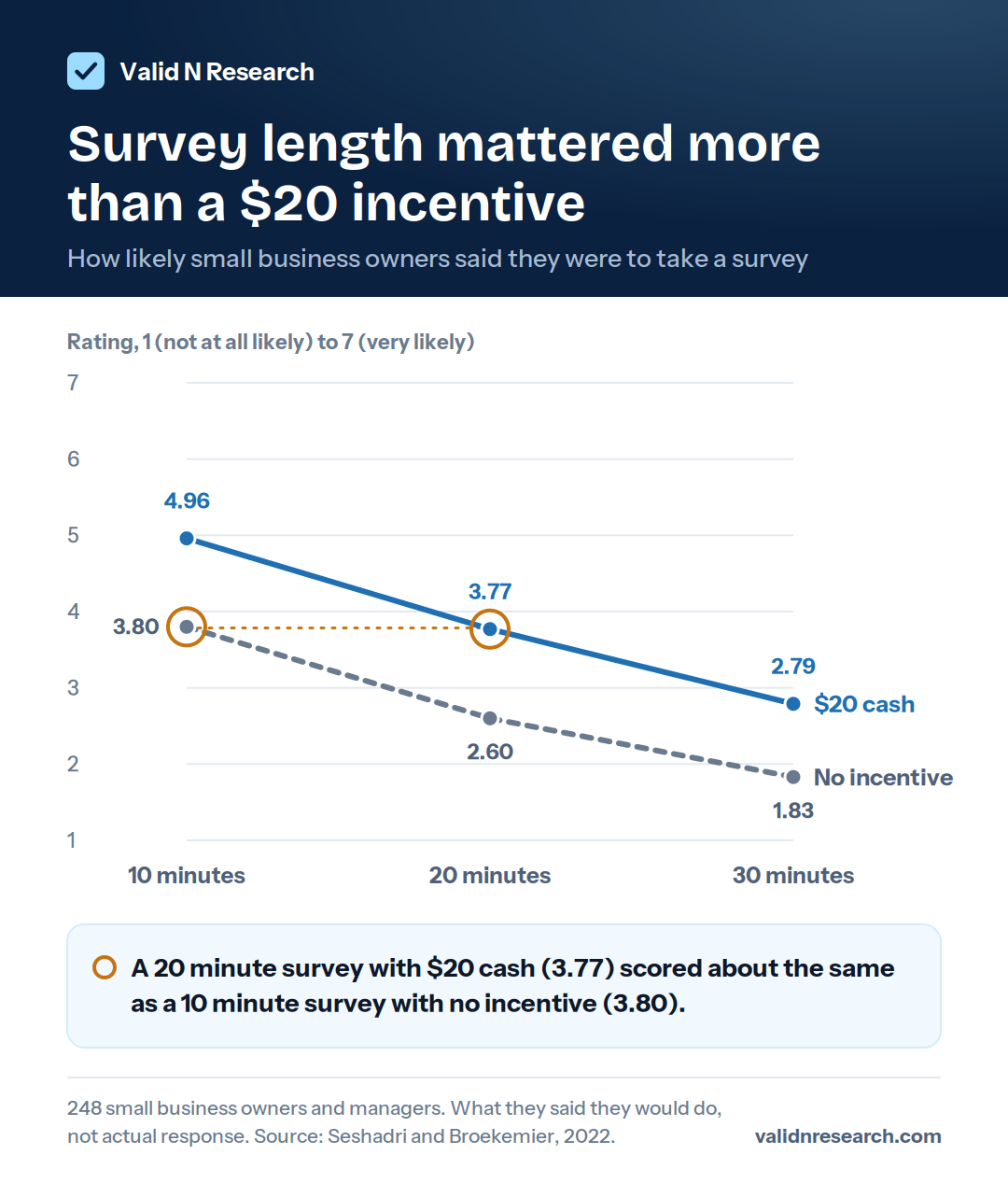
Two caveats. The study measured what people said they would do rather than what they actually did. Less than 1% of the owners and managers the researchers contacted took part, so the people who responded may not be representative. Treat the results as indicative of the likely direction rather than as a prediction of actual response rates.
How does survey length affect response rates?
Longer surveys tend to get fewer responses, but the size of the effect varies, and both the length you state in the invitation and the real length matter.
- Controlled trialsIn the 2023 Cochrane review of methods to increase response, a shorter questionnaire raised the odds of response to electronic questionnaires by about 51%, though results varied a lot between trials. Higher odds aren't the same as that many more percentage points: if 20% of people would respond to the longer version, 51% higher odds brings that to about 27%.
- Stated lengthGalesic and Bosnjak (2009) told people, at random, that a web survey would take 10, 20 or 30 minutes. The longer the stated length, the fewer people started and the fewer completed it.
- Length and contentA 2011 meta-analysis by Rolstad, Adler and Rydén of 20 studies found that longer questionnaires had lower response rates. The studies couldn't disentangle length from content, so length alone may not be the explanation for the gap. The authors recommended selecting questions on the basis of their content rather than their length.
- A recent testIn a 2025 experiment by Hanson and colleagues, a general population survey was carried out in Austria, with half the sample given the shorter version (announced as 35 minutes, 182 questions) and the other half the full version (announced as 50 minutes, 274 questions). Response was 38% for the shorter version and 34% for the longer one. The difference was statistically significant but very small, and the authors found no clear difference in who responded or in the quality of the responses.
While reducing survey length generally contributes to higher response rates, the increase from a single reduction may be modest. And a higher response rate doesn't automatically mean a more representative sample, as discussed in our guide to B2B survey response rates. Length also affects cost and data quality. Shorter surveys cost less per complete and can help maintain data quality by reducing respondent fatigue, which strengthens the case for keeping surveys as short as possible.
Does survey length affect data quality?
Often, and predominantly at the end of the survey. Galesic and Bosnjak rotated blocks of questions so that the same questions appeared early in the survey for some respondents and later for others. Answers to questions that came later in the survey were faster, shorter and more uniform than answers to the same questions that came earlier. In practical terms, that equates to less time per question, shorter answers to open ended questions and less variation in answers across a grid (at the extreme, this is straightlining). This reduction in effort later in the survey is often referred to as respondent fatigue, or survey fatigue.
The effect isn't guaranteed. In the Austrian experiment, skipped questions and identical answers in the grids were about the same in the 35 and 50 minute versions. But the risk is concentrated toward the end, where people get tired, so you do need to plan for it:
- Put the most important questions first. These are your key measures and any open ended questions you intend to quote. Asking them early protects them from the fatigue that can lead to less careful answers toward the end.
- Check the later sections separately. Compare the time per question and the level of straightlining in the final section with that in the first. A respondent who rushes through the end may still have answered the first section carefully.
- Use the same quality checks as any B2B survey. Our guide to preventing survey fraud covers speeding, straightlining, and open end checks, and how to avoid removing honest respondents.
Does survey length affect drop off?
Drop off, also called breakoff, means starting a survey and not finishing it. Longer surveys tend to lose more people along the way.
- Across real surveysLiu and Wronski (2018) analyzed more than 25,000 real web surveys and found that completion rates fell as surveys got longer and the questions got harder. These were comparisons between surveys, not experiments, so other differences between them may play a part.
- On phonesA meta-analysis of 14 studies by Mavletova and Couper (2015), covering 39 samples of mobile web surveys, found an average breakoff rate of 6.6%. Compared with a 5 minute survey, a 30 minute survey had about 42% higher odds of breakoff, though the length effect fell just short of statistical significance. Surveys designed for mobile had lower odds of breakoff, and stating the expected length in advance made no measurable difference to breakoff.
Progress bars in 32 experiments
Each bar as it would look halfway through the survey
- Steady paceNo significant effect
- Slow, then fastMore drop off
- Fast, then slowLess drop off, but overstates progress
A progress bar isn't a reliable fix for a long survey. A meta-analysis of 32 experiments by Villar, Callegaro and Yang (2013) found that a progress bar moving at a steady pace didn't significantly reduce drop off. A bar that moved slowly at first and faster later increased drop off, while one that moved quickly at first and more slowly later appeared to reduce it. The authors cautioned that the second pattern overstates progress early in the survey. In the Liu and Wronski data, surveys without progress bars had higher completion rates.
Why do surveys take longer on a phone?
Couper and Peterson (2017) found that web surveys take longer on smartphones than on computers, whether people chose their device or were randomly assigned one. The time taken to move between pages accounted for about a fifth of the difference. Much of the remainder was attributable to the extra scrolling required on a phone, particularly with grid questions.
A survey that takes 12 minutes on a laptop will generally take longer on a phone (particularly if it has large grids). If some of your respondents are going to be answering on a phone:
- Time the survey on a phone as well as on a computer.
- Break the large grids down into smaller sets, or just ask the items one at a time.
- Use a design built for mobile. In the mobile meta-analysis, surveys designed for mobile had about 29% lower odds of breakoff among phone respondents than surveys that weren't.
How to measure survey length (LOI)
Length of interview (LOI) is how long the survey takes a typical respondent, usually reported as the median in minutes. It's the number a panel supplier quotes and plans on, and the number your invitation should state.
- Time it with real respondents. Your team knows the questions, so their timings run short. Use the median time from a soft launch, the first slice of fieldwork.
- Use the median, not the average. A few people leave a survey open in another tab, and their times pull the average up.
- Time each path. If different groups see different sections, check the median for each one. The longest path is the real length for the people on it.
- Include the screener. Qualified respondents answer it too.
- State the real length in the invitation. Understating it may get more people to start, but it breaks the promise you made to them, and a supplier's price and field plan depend on the length you give.
How to shorten a B2B survey
Long surveys often include questions that don't change any decision. Before cutting individual words, cut whole questions.
- Tie every question to a decision or an analysis. If no one can say what they'd do differently based on the answer, drop it.
- Don't ask what you already know. Panel suppliers often hold profile data such as company size, industry, and job function. Ask what they can append to the data instead of asking again, and keep the questions that confirm someone qualifies in the screener.
- Use skip logic so people see only the questions that apply to them.
- Trim grids. Remove items that measure the same thing, and split long grids into shorter ones.
- Limit the number of open ended questions to reduce the burden on respondents, and put the essential ones at the beginning of the survey. In Galesic and Bosnjak's experiment, answers to open ended questions were shorter when the questions came later, so asking early gets you fuller answers.
- Move nice to know topics to a later study, or show each respondent a random subset of modules. A subset design needs more completes to get a usable base for each module, so check the numbers with a sample size calculator first.
Don't split one long survey into two requests to the same people. In an experiment by Peytchev and colleagues (2020), asking for a survey in two parts, with the request for the second part made at the end of the first, led to more nonresponse, not less.
When a long survey can't be avoided
Some designs need time. A conjoint study, a MaxDiff exercise, or a detailed usage audit can run past 20 minutes even after cutting. In that case:
- Say so up front, and pay for the time. Our guide to B2B survey incentives covers setting the amount.
- Put the core exercise early, before the profiling and background questions.
- Design for phones, or tell respondents in the invitation if the task is easier on a larger screen.
- Check the late sections for speeding and straightlining before you accept the data.
- Budget for it. Panel suppliers price on incidence and length, so each extra minute raises the cost per complete. Our cost per complete benchmarks use a rule of thumb of about 3% per minute beyond 10 minutes, and the cost per complete estimator shows the effect for your audience.
Sources
The studies this guide draws on. Each title links to the original.
- Couper, M. P., and Peterson, G. J. (2017). Why do web surveys take longer on smartphones?. Social Science Computer Review, 35(3), 357-377.
- Edwards, P. J., Roberts, I., Clarke, M. J., DiGuiseppi, C., Woolf, B., and Perkins, C. (2023). Methods to increase response to postal and electronic questionnaires. Cochrane Database of Systematic Reviews, Issue 11, MR000008.
- Galesic, M., and Bosnjak, M. (2009). Effects of questionnaire length on participation and indicators of response quality in a web survey. Public Opinion Quarterly, 73(2), 349-360.
- Hanson, T., Aizpurua, E., Fitzgerald, R., and Vukovic, M. (2025). Surely shorter is better? A questionnaire length experiment in a self-completion survey. Survey Research Methods, 19(2), 139-152.
- Liu, M., and Wronski, L. (2018). Examining completion rates in web surveys via over 25,000 real-world surveys. Social Science Computer Review, 36(1), 116-124.
- Mavletova, A., and Couper, M. P. (2015). A meta-analysis of breakoff rates in mobile web surveys. In D. Toninelli, R. Pinter, and P. de Pedraza (Eds.), Mobile research methods: Opportunities and challenges of mobile research methodologies (pp. 81-98). Ubiquity Press.
- Peytchev, A., Peytcheva, E., Conzelmann, J. G., Wilson, A., and Wine, J. (2020). Modular survey design: Experimental manipulation of survey length and monetary incentive structure. Journal of Survey Statistics and Methodology, 8(2), 370-384.
- Revilla, M., and Höhne, J. K. (2020). How long do respondents think online surveys should be? New evidence from two online panels in Germany. International Journal of Market Research, 62(5), 538-545.
- Revilla, M., and Ochoa, C. (2017). Ideal and maximum length for a web survey. International Journal of Market Research, 59(5), 557-565.
- Rolstad, S., Adler, J., and Rydén, A. (2011). Response burden and questionnaire length: Is shorter better? A review and meta-analysis. Value in Health, 14(8), 1101-1108.
- Seshadri, S., and Broekemier, G. M. (2022). Small business executives' online survey response intentions: The effects of incentives and survey length. Small Business Institute Journal, 18(2), 1-9.
- Villar, A., Callegaro, M., and Yang, Y. (2013). Where am I? A meta-analysis of experiments on the effects of progress indicators for web surveys. Social Science Computer Review, 31(6), 744-762.
Related guides
B2B survey response rates
Published benchmarks for B2B and executive surveys, what raises response, and when a low rate matters.
Read the guideB2B survey incentives
What works, how much to pay, and who can't accept one, from the research on survey incentives.
Read the guideHow to prevent survey fraud and AI bots
AI agents and fake decision makers, a layered defense, false positives, and what to ask any supplier.
Read the guideB2B survey length: frequently asked questions
How long should a B2B survey be?
A B2B survey should be as short as its objectives allow, with 10 minutes or less being ideal and rarely more than 20 minutes. In two studies, online panel members put the median ideal length at 10 to 15 minutes and the median maximum at 20 to 25 minutes. Small business owners were also much less willing to take a 20 or 30 minute survey than a 10 minute one. Keeping surveys short tends to help both response rates and the quality of answers.
What is LOI in a survey?
LOI stands for length of interview. It's how long the survey takes a typical respondent, usually reported as the median in minutes. Panel suppliers use it, with incidence, to price and plan fieldwork.
How many questions can you ask in a 10 minute survey?
It depends on the questions. A yes or no question is quick, while a large grid or an open ended question takes much longer, and everything takes longer on a phone. Rather than counting questions, time the survey with real respondents and use the median.
Does survey length affect response rates?
Yes. In the Cochrane trials of electronic questionnaires, a shorter questionnaire raised the odds of response by about 51%, and telling people a web survey would take longer reduced the number who started and finished it. The gain from a single cut can be modest, so length isn't the only lever.
Does survey length affect data quality?
It can. When the same questions came later in a long web survey, answers were faster, shorter, and more uniform. Put the most important questions early and check the last sections for speeding and straightlining.
What is the ideal survey length for executives?
There's little published evidence on survey length for executives specifically. In a study of small business owners and managers, a 20 minute survey with $20 cash was rated about as appealing as a 10 minute survey with no incentive. Keep surveys for senior audiences as short as possible, and tell them the real length up front.
Should you tell respondents how long the survey will take?
Yes, and give the real median length. A longer stated length can reduce how many people start, but understating it breaks your promise to respondents, and suppliers plan and price fieldwork on the length you give.
Do progress bars reduce drop off?
Not reliably. In a meta-analysis of 32 experiments, a progress bar moving at a steady pace didn't significantly reduce drop off, and one that moved slowly at first and faster later increased it. Shortening the survey is likely to do more to reduce drop off than a progress bar.
Why do surveys take longer on mobile phones?
Mostly because of scrolling, especially on grid questions. In one analysis, the time spent moving between pages explained about a fifth of the extra time on smartphones, and much of the rest came from extra scrolling. Time your survey on a phone, and break up large grids.
Does a longer survey cost more?
Usually. Panel suppliers price on incidence and length, so each extra minute raises the cost per complete. Our cost per complete benchmarks use a rule of thumb of about 3% per minute beyond 10 minutes, before any effect on drop off.
Send the spec. Get real numbers back.
Audience, market, target n, expected interview length. Feasibility the same business day for standard audiences, with reachable counts, an estimated qualification rate we believe and a quoted cost per complete that stays fixed for the agreed brief.